


Breakthroughs in Polymers (BIP) Forum
2026 Session
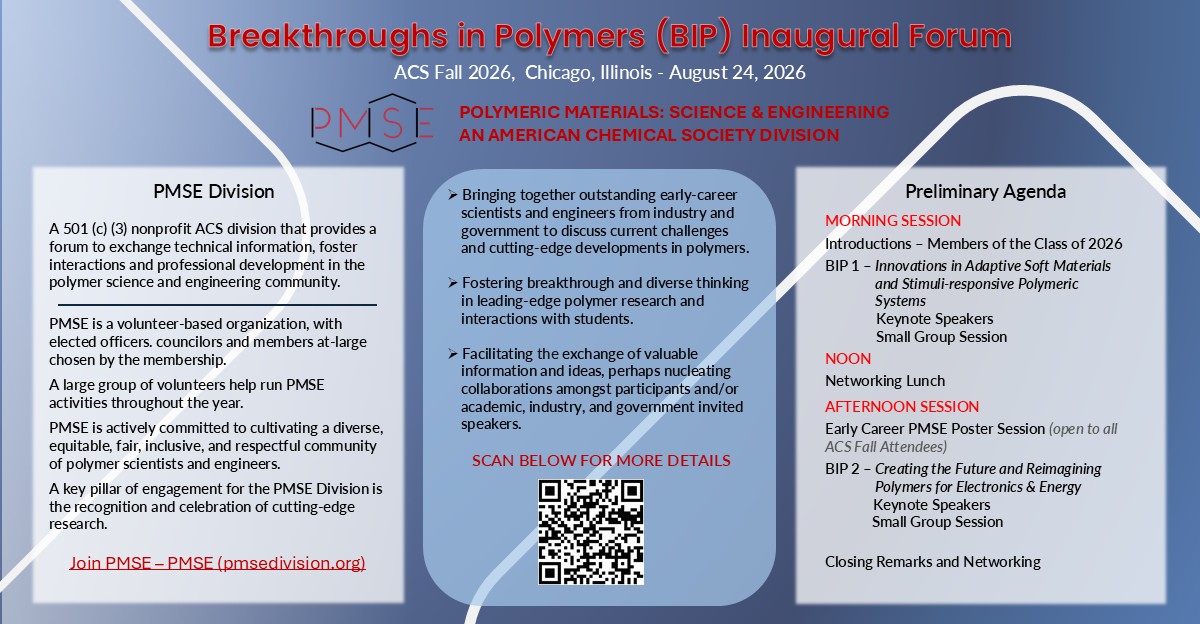
Nominations are open for the 2026 Breakthrough in Polymers forum. The two sessions for 2026 are
- BIP 1 – Innovations in Adaptive Soft Materials and Stimuli-responsive Polymeric Systems
- BIP 2 – Creating the Future and Reimagining Polymers for Electronics & Energy
Please consider nominating using the form on the right.
2025 Invitees
The first BIP forum was held in 2025. Invited keynotes speakers were invited for the topics of “Polymer Innovation via Digitalization” and “Critical Polymeric Materials and Sustainability”
- Chin-Men Cheng, Henkel Corporation
- Richard Vaia, Air Force Research Laboratory
- Jill Martin, Dow Chemical Corporation
- Karen Wooley, Texas A&M University
The BIP Forum attendees were
- Akash Arora, Dow Chemical Company
- Tianran Chen, DuPont
- Adelyn Crabtree, Henkel
- Obed Dodo, Estee Lauder Companies
- Erika Drucker, Estee Lauder Companies
- Jeffrey Ethier, Air Force Research Laboratory
- Miguel Gonzalez, Exponent Inc.
- Matthew Grasinger, Air Force Research Laboratory
- Nisha Hollingsworth, Solventum
- Zaili Hou, World Centric
- Amber Hubband, Oak Ridge National Laboratory
- Christopher Kasprak, Dow
- Michael Kelly, Hexcel
- Hansol Lee, 3M
- Michell Lehmann, Oak Ridge National Laboratory
- Aaron Liu, BASF
- Cong Liu, National Institute for Materials Science, Japan
- Alessandro Perego, 3M
- Thomas Ribelli, Avery Dennison Corporation
- Ashlin Sathyan, DuPont
- Mike Sims, Synesqo
- James Sitter, U.S. Naval Research Laboratory
- Mark Sullivan, Citrine Informatics
- Travis Thornell, U.S. Army Research and Development Center
- Shruti Venkatram, 3M
- Dane Wedgeworth, U.S. Army Research and Development Center
Award Details
Please see the nomination form for full award details.
History
BIP forum was initiated in 2025.
Award and Nomination Summary
Purpose
Originally established to recognize and encourage high quality presentations and submissions during PMSE symposium by by the Union Carbide Corporation as the Carbide Award. The award title was later changed to recognize Arthur K. Doolittle’s contribution to the ACS Division of PMSE, the field of polymeric materials, and his financial contributions from royalties of Technology of Solvents and Plasticizers.
Rules of Eligibility
The nomination period ends on Friday, March 27, 2026 (extended deadline).
Peer and self-nominations are accepted. Individuals from groups historically underrepresented in STEM are highly encouraged to apply.
- Invited participants will be early career scientists and engineers from industry, government or other non-academic research organizations. PMSE defines “early-career scientist or engineer” as a member who is no more than 7 years beyond the start of their independent research career (postdoc period is included in this 7 years).
- All participants need to be members of ACS and the PMSE Division at the time of the nomination and the meeting
Nominations Process
Please review the submission document at: https://pmsedivision.org/2026-bip-criteria-and-nomination-form/, which will be available until the nomination period closes.
Award Selection
Participants do not need to have expertise in the topics to be discussed. The selection committee will be composed of PMSE volunteers.
Award Announcement and Nature
The selection committee will start sending invitations to invited members of the inaugural class by March 23, 2026, and invited participants will need to confirm their participation by April 15, 2026.
Invited participants are expected to present a poster during the forum. Poster abstracts need to be submitted per the instructions in the invitation letter. Poster topics can be about participants’ current research, their work field, or their student research topic.
PMSE will provide reimbursement for registration fees and one night of hotel stay for participants up to $850 per participant, if requested.
Transportation to the conference will need to be covered by the participant or the participant’s organization.